
LazyBar Casino KYC & AML — Verification for Canadian Players
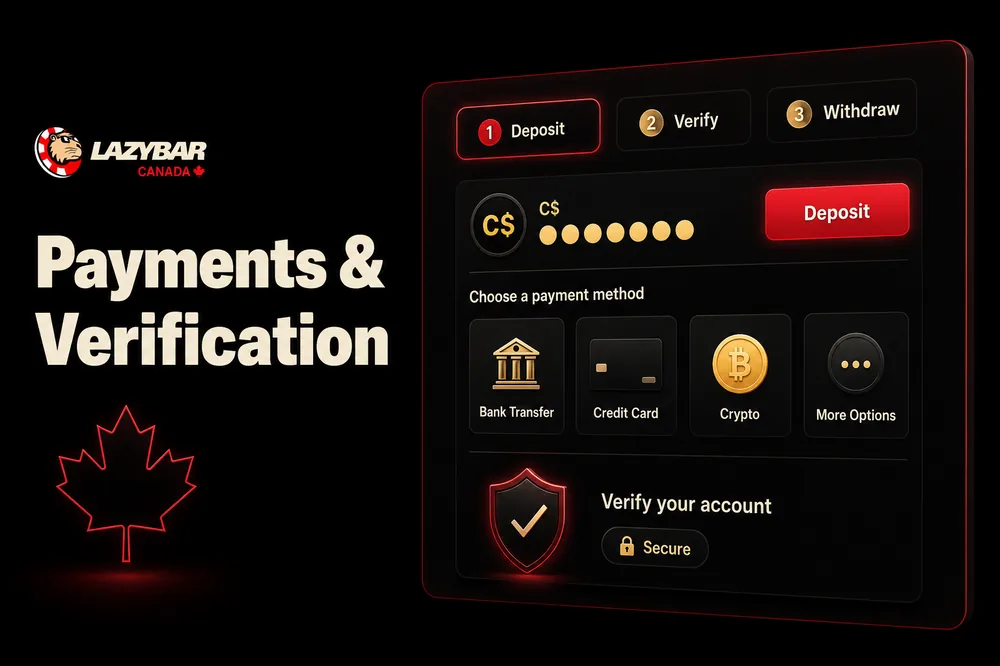
If you play at LazyBar Casino for real money, at some point you will meet KYC — the identity check that stands between your cleared winnings and your first payout. Let me be straight with you up front: this is a genuine point of friction. You can sign up, deposit C$20 by Interac and play thousands of games without showing a single document, but the moment you request your first withdrawal, LazyBar asks you to prove who you are. That surprises players who expected an instant cash-out, and it's the single most common reason a first payout feels slow. This page walks through exactly what KYC and AML mean, which documents you'll be asked for, precisely when the check hits, how long it takes, why a Curaçao-licensed operator is legally required to do it, and — most usefully — how to clear it in one pass so it never slows you down again. Everything here reflects the live Canadian site as I tested it in July 2026 on the LazyBar Casino Curaçao site.
What is KYC?
KYC stands for Know Your Customer. It's the process by which a licensed gambling operator confirms that you are a real, identifiable person — of legal age, using your own money, and not someone the operator is legally barred from serving. In plain terms, KYC answers three questions: Are you who you say you are? Are you old enough to gamble? Is the money genuinely yours? It is not a LazyBar quirk and it is not a hurdle invented to keep your winnings. Every regulated casino on the planet runs KYC, because it's a condition of holding a licence at all.
For a Canadian player the practical shape of KYC is simple: you upload a few documents once, a review team checks them against your account details, and if everything matches, your account is marked verified. From that point on, KYC is done — you won't be asked again for routine play, and every withdrawal after your first sails straight through the payout queue with no document step at all. The pain, such as it is, is one-time. That's the framing to carry through the rest of this page: KYC is a gate you walk through once, not a wall you hit every time.
KYC and AML get blurred together a lot, so it helps to separate them. KYC is about identity — proving who you are. AML (anti-money-laundering, covered further down) is about the money — making sure funds moving through the casino are clean and legitimate. The two overlap and are usually handled by the same verification team, but they answer different regulatory questions. KYC checks the person; AML checks the cash flow.
Documents you'll need
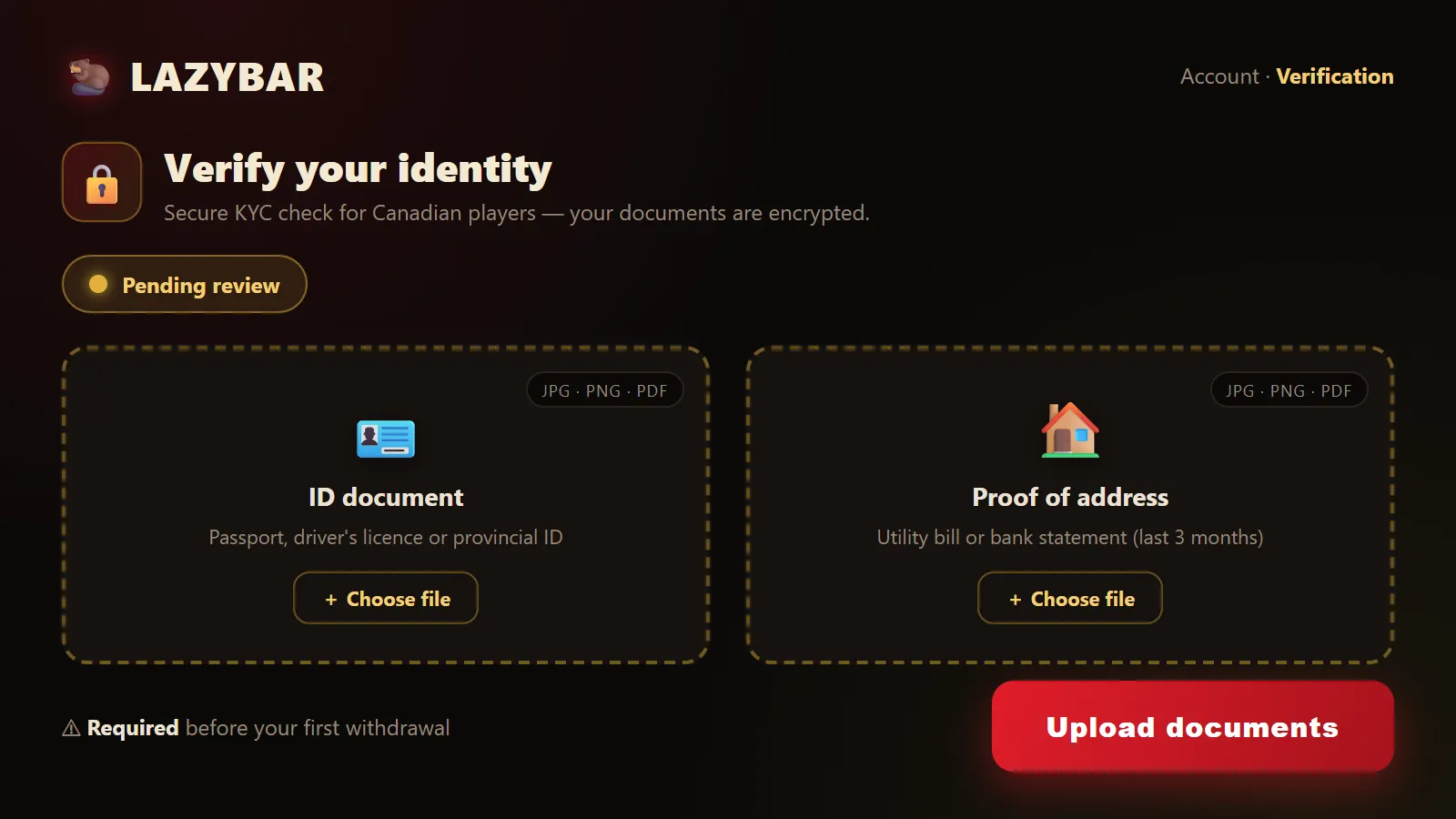
Here's the standard document set a Curaçao-licensed operator like LazyBar asks for. Have these ready before you request your first withdrawal and the whole thing takes minutes, not days:
| Document | What proves it | What they check |
|---|---|---|
| Government photo ID | Passport, driver's licence, or provincial ID card | Your name, date of birth (age 19+, or 18+ in AB/MB/QC), photo, and that the document is valid and unexpired |
| Proof of address | Recent utility bill, bank statement, or government letter (usually within the last 3 months) | Your name and residential address match your account registration |
| Proof of payment method | A photo of your card (with middle digits hidden), a bank/Interac screenshot, or crypto wallet confirmation | The deposit method belongs to you and matches the account name |
A few honest, practical notes on each. For the photo ID, make sure all four corners are visible, the text is sharp, and there's no glare washing out the details — a blurry or cropped ID is the number-one cause of a rejected upload and a needless second round. A passport or a provincial driver's licence both work fine.
For proof of address, the document has to be recent (typically within 90 days) and it must show your name and address clearly. A utility bill, a bank statement, or an official government letter all qualify. What usually doesn't qualify: anything without your address on it, a screenshot that crops out the date, or a mobile-phone bill from some providers. When in doubt, a bank statement is the safest bet.
The payment-method proof isn't always requested, but when it is, the rule is simple: never send the full card number. Cover the middle eight digits — the first six and last four are all the verification team needs, and every legitimate operator tells you to hide the rest. If you deposited by Interac e-Transfer or crypto, a transaction screenshot from your bank or wallet does the same job.
When does KYC happen? (Before your first withdrawal — the real friction point)
This is the timing that catches people out, so I'm giving it its own section. LazyBar runs KYC at the first withdrawal, not at registration. You can:
- Register in a couple of minutes with just an email, password and currency — no ID.
- Deposit C$20 by Interac and start playing immediately — no ID.
- Play thousands of slots, live tables and sports markets, claim the welcome bonus, and build a real-money balance — still no ID.
Then you go to cash out for the first time, and that's when the verification request appears. From the player's side it can feel like a speed bump arriving out of nowhere — you had a frictionless deposit-and-play experience, and now there's a document upload standing between you and your money. Let me be candid: this is real friction, and it's the moment most "LazyBar payout is slow" complaints are actually describing. They're not describing a slow transfer; they're describing the first-time KYC review that has to complete before the payout clock even starts.
The upside of this "verify-at-withdrawal" model is that getting started is genuinely fast — you're not blocked from playing while documents are reviewed. The downside is that if you leave KYC until the exact moment you want your winnings, you add a review delay to your first payout. The fix is entirely in your hands, and I'll get to it: verify before you need to, and the friction disappears. Once you're verified, every subsequent withdrawal skips this step entirely — see how the payout timers work on the withdrawals page, where the KYC gate is the biggest variable on a first cash-out.
LazyBar's AML policy — what it is and why it exists
AML stands for Anti-Money-Laundering. Where KYC verifies you, AML monitors the money — it's the framework that stops criminals from washing illicit funds through a casino by depositing dirty money and withdrawing it as "gambling winnings." A licensed operator is legally obligated to run AML controls, and Curaçao-licensed sites are no exception.
In practice, LazyBar's AML controls mostly stay invisible to an ordinary player. They surface in a few situations:
- Source-of-funds checks on large sums. If you deposit or withdraw unusually large amounts, the operator may ask for evidence of where the money came from — a payslip, a bank statement, or similar. This is standard and applies at every regulated casino; it isn't an accusation.
- Matching deposit and withdrawal methods. AML rules generally require winnings to be paid back to the same method you deposited with (the "closed-loop" principle). This is precisely why the payment-method proof exists — it confirms the money is going back to you, not being routed elsewhere.
- Monitoring for unusual patterns. Rapid deposits and withdrawals with little actual play, or activity that doesn't fit a normal gambling pattern, can trigger a review. Again, for a genuine player this almost never bites.
The honest takeaway: for the vast majority of Canadian players betting normal amounts, AML is a background process you'll never consciously notice. It only becomes visible if you move large sums or your deposit and withdrawal don't line up. None of it is a reason for concern — it's the same machinery that protects legitimate players and keeps the operator's licence intact.
How long does verification take?
When your documents are clear and match your account, verification is usually quick — commonly within a few hours, and often faster during business hours. Here's the realistic picture:
| Scenario | Typical timeline |
|---|---|
| Clean documents, submitted during business hours | A few hours, sometimes under one |
| Clean documents, submitted overnight / weekend | Reviewed once the team is back; can stretch to 24 h |
| Blurry, cropped, or mismatched documents | Rejected and re-requested — adds a full round-trip (often the real cause of "slow" verification) |
| Source-of-funds check on a large amount | Longer; depends on the additional evidence requested |
The single biggest thing that stretches this timeline isn't the operator being slow — it's a document that has to be resubmitted. A dark, glare-covered ID or a proof-of-address that crops out the date bounces back, and you lose a whole review cycle. Get the uploads right the first time and verification is typically a same-day, often same-hour, affair. Crucially, the payout timers on your withdrawal only start once verification clears, so a fast KYC directly means a fast first cash-out.
Why is KYC/AML required at all?
It's fair to ask why a casino you just want to play at needs your passport. The reasons are concrete, not bureaucratic box-ticking:
- Licensing obligation. LazyBar operates under a Curaçao licence, and identity verification plus AML controls are conditions of holding that licence. No KYC, no licence — it's that fundamental. You can read how the licensing framework works on the license page.
- Age verification. Gambling is restricted to 19+ across most of Canada (18+ in Alberta, Manitoba and Quebec). KYC is how the operator confirms you're legally old enough — a protection for players, not an obstacle.
- Fraud and account protection. Verifying identity stops someone else from opening an account in your name or cashing out to a stranger's method. It protects your money as much as the operator's.
- Anti-money-laundering law. Operators are legally required to prevent their platform being used to launder funds. AML checks are the mechanism.
- Responsible gambling. Verified identity underpins tools like self-exclusion and cross-account limits — you can't enforce a self-exclusion on an anonymous account. If you ever want those safeguards, see the responsible gambling tools.
So while KYC is a friction, it's a friction with a purpose: it's the same set of checks that keeps the platform legal, keeps minors out, and keeps your winnings going to you. Framed that way, it's a feature of a legitimate operator, not a bug.
Tips to pass KYC fast
Here's the practical checklist I'd give any Canadian player to clear verification in a single pass and never think about it again:
- Verify before you need it. Don't wait for the withdrawal-day prompt. Upload your ID and proof of address soon after registering, so your first payout isn't waiting on a review. This one habit removes almost all of the perceived "slow payout" problem.
- Use a sharp, full-frame photo of your ID. All four corners visible, no glare, text legible. Natural light and a flat surface beat a phone flash.
- Make sure your proof of address is recent and matches. Within 90 days, showing your name and the exact address on your account. A bank statement is the safest choice.
- Match your registration details exactly. The name, date of birth and address on your documents must match what you entered at sign-up. A nickname or an old address is a common mismatch that triggers a rejection.
- Hide the middle card digits. If asked for payment proof, cover the middle eight — first six and last four only. Never send a full card number.
- Keep deposit and withdrawal methods the same. Paying out to the method you deposited with smooths the AML check and avoids extra questions.
- Submit during business hours if you can. Reviews tend to move faster when the team is active, versus an overnight or weekend queue.
Do those seven things and KYC becomes a one-time, same-day formality. New to the platform and haven't opened an account yet? The registration guide walks through sign-up step by step — do that first, verify early, and your first withdrawal will be friction-free.
FAQ
When do I have to verify my identity at LazyBar Casino?
KYC happens before your first withdrawal, not at registration. You can sign up, deposit and play with no ID check — but when you request your first cash-out, you'll be asked to upload a government photo ID and proof of address. It's a one-time step; every withdrawal after that skips it.
What documents does LazyBar KYC require?
A government photo ID (passport, driver's licence or provincial ID), a proof of address dated within about 90 days (utility bill, bank statement or government letter), and sometimes proof of your payment method (card with middle digits hidden, or a bank/wallet screenshot). Clear, full-frame images that match your account details clear fastest.
How long does LazyBar verification take?
With clean, matching documents it's often a few hours and sometimes under one during business hours; overnight or weekend submissions can stretch toward 24 hours. The biggest delay is a blurry or mismatched upload that has to be resubmitted, so getting the images right the first time is what keeps it fast.
Why does LazyBar need my ID — is it safe to send?
KYC and AML checks are a legal condition of the operator's Curaçao licence: they confirm you're 19+ (18+ in AB/MB/QC), that the money is yours, and that no one else is using your account. Sending documents to a licensed operator through its secure verification portal is standard practice at every regulated casino.
Can I withdraw without completing KYC?
No. Verification is mandatory before your first payout is released — it's an AML and licensing requirement, not optional. The good news is it's one-time: verify once and every subsequent withdrawal goes straight through with no document step.
Get verified early and cash out with no friction
KYC is the one genuine speed bump at LazyBar, and it's entirely avoidable as a delay: upload a sharp ID and a recent proof of address soon after you register, and your first withdrawal won't wait on a review. Do it once and you're set for good.
19+ (18+ in AB/MB/QC) · Play responsibly · Canada excluding Ontario · LazyBar-casinos.ca is an independent affiliate, not the operator. Verification and AML requirements are set by the operator and shown on the live site; links may earn us a commission.